
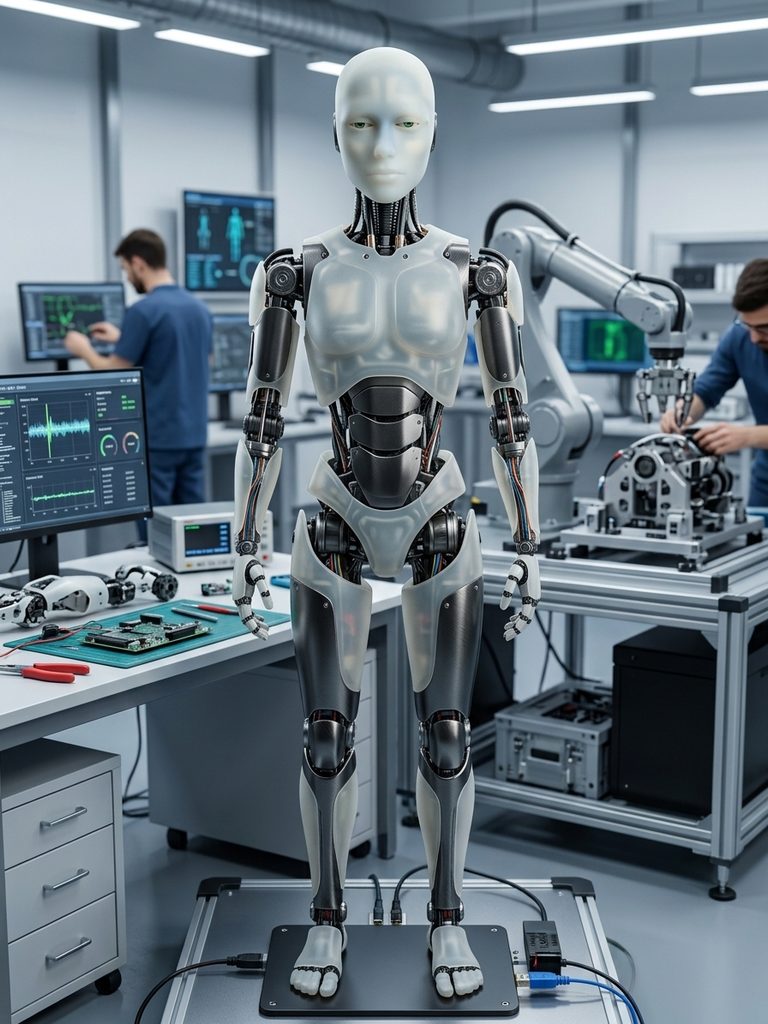
What the humanoid robot could look like! Not my actual workshop (or robot) but generated by Gemini.
I have been constructing the Inmoov robot for some years now, on and off. It started around 2014, when I decided that creating a simple humanoid robot would be a good thing to try and do. It’s been more off than on, and I have shelved the project many times (for lack of time and motivation) but this summer decided that I need to get it finished. I’m glad that it has prgressed as there is a rather strange moment in building a humanoid robot when a collection of motors, wires, screws and 3D-printed plastic suddenly begins to look back at you.
My robot head began, appropriately enough, as a collection of files downloaded from the Inmoov website. InMoov, the open-source humanoid robot created by French sculptor and designer Gaël Langevin provides all the .stl files you need to 3D print your own humanoid robot. InMoov began in 2012 with the design of a 3D-printable prosthetic hand and subsequently developed into a complete life-sized humanoid robot. One of the things that makes the project particularly appealing is that it is not intended to be a sealed commercial product. Its components can be printed, assembled and modified by anybody with access to relatively modest fabrication facilities.
That philosophy was one of the things that attracted me to the project. I was less interested in constructing a humanoid robot simply for the sake of reproducing somebody else’s design than in using it as a starting point. Building the head would allow me to understand its mechanics and electronics from the inside, before gradually modifying it into a platform for starting some experiments in social robotics and inclusive human–robot interaction (which is now my goal).
A robot does not necessarily have to look human, communicate like a human or even possess a face. Industrial robots can perform sophisticated operations without needing to smile, establish eye contact or communicate an emotional state. A social robot, however, operates in a different design space. Here, movement, appearance, gaze, gesture, expression, sound and behaviour can all become part of the interaction between human and machine.
This raises an interesting question: If we are going to build robots that communicate socially with people, who gets to decide what that communication should look like?
That question is increasingly central to where I want to take this project.
Starting with the i2Head
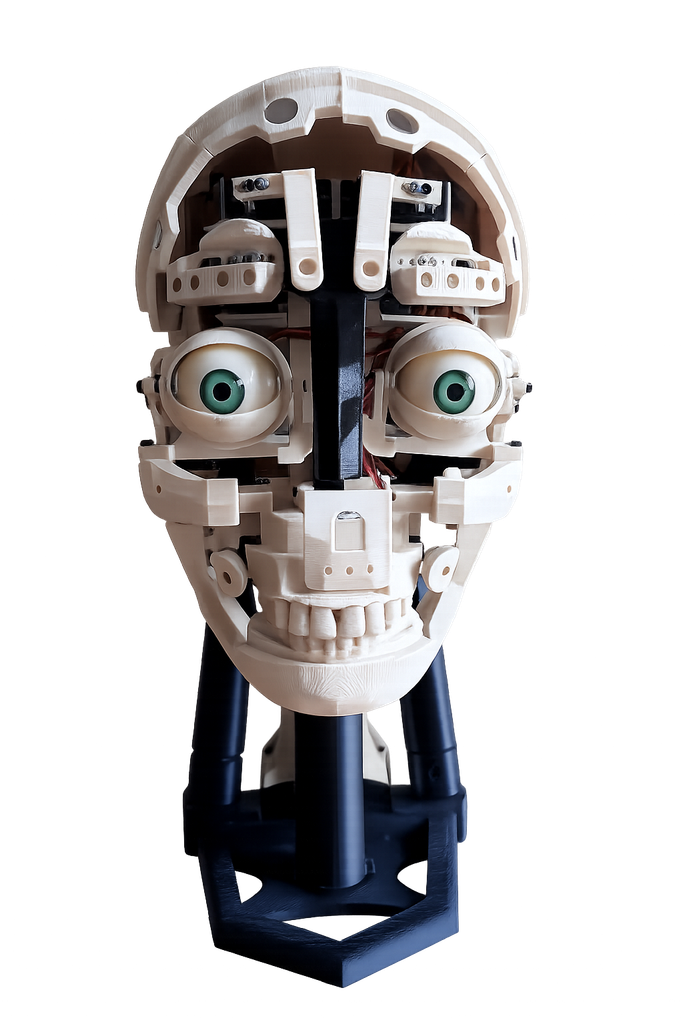
The head I chose to construct originally was the simpler version 1 head, and that is attached to the robot body. However, the original head is quite static and devoid of expression – the newer i2Head has a silicone face and can smile, frown, and express many different emotions quite well. Unlike the earlier InMoov head, the new version has been designed specifically to support considerably greater facial movement and expression.
Beneath the face is a collection of 3D-printed components, mini servos, linkages and wiring. Separate mechanisms operate the eyes and eyelids, while additional actuators can move parts of the eyebrows, cheeks, forehead and mouth. The jaw itself is articulated.
Before any of this can work, however, it has to be 3D printed.
The head consists not of one large 3D print but of numerous individual components. This is one of the pleasures (and occasional frustrations) of building an open-source robot. Parts emerge from the printer looking relatively insignificant, but often need some filing and scraping to make them fit together.
Dimensional accuracy matters. A component that is fractionally too tight may prevent a mechanism moving freely; one that is fractionally too loose may introduce unwanted movement. Servo positions have to be established before linkages are attached, and moving components have to be checked continually to ensure that nothing catches as the mechanism travels through its range.
Eventually, however, the collection of printed components began to acquire a recognisable anatomy. There were eye sockets, a jaw, teeth, cheek mechanisms and the beginnings of a skull. And, perhaps most strikingly, the two large green eyes (which I bought from eBay, rather than trying to 3D print them).
With the outer face absent, the result has an unexpectedly anatomical quality. It looks less like a conventional robot and more like a mechanical dissection. The functional equivalents of muscles and bones are exposed, except that tendons have become linkages, muscles have become servos and the skull has emerged layer by layer from a 3D printer. At this stage the head was already fascinating. The eyes could move, the jaw could open and close and different parts of the face could be actuated. But it was still unmistakably a
Making a Face
One of the nice features of the i2Head is that its face is not intended to be another rigid 3D-printed shell. Instead, the mechanical structure can be covered by a flexible silicone skin.
Creating that skin requires another substantial piece of 3D printing: a mould for the face. The mould is produced as a collection of interlocking printed components. Rather than printing the face itself, these pieces define its inner and outer surfaces. When assembled, they create the thin cavity into which liquid silicone can be introduced.
Looking at the open mould is rather uncanny: on one side is a recognisable face projecting outwards; on the other, its inverted counterpart appears to look back from inside the mould.
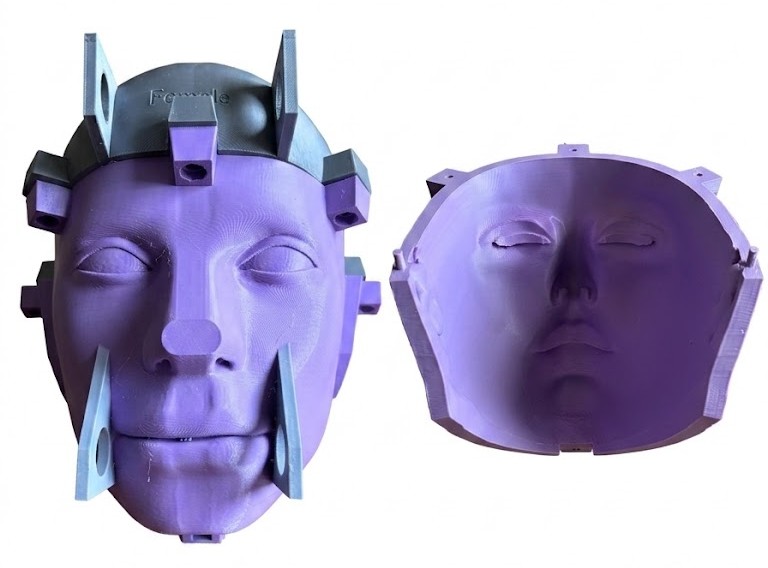
Into the space between those surfaces goes the silicone. I used 20A silicone, which is reasonably soft, but as it turns out not quite soft enough for the servos, which are quite small and low powered. Hence, I am in the process of making a new face with a much softer variant of silicone (00-10 super soft silicone).
After curing, the mould can be separated and the flexible face carefully removed. In practice this was really difficult, and I had to break one part of the mould up in order to remove the face. You really have to use lots of mould release spray on all of the parts of the mould! What eventually emerges is extraordinarily different from the rigid mechanical structure underneath it: translucent, soft and elastic, with eyelids, lips, cheeks, nose and the subtle contours that we instinctively recognise as a human face. Creepy, but a face all the same (See article on the Uncanny Valley: https://spectrum.ieee.org/the-uncanny-valley).
Fitting it to the head required magnets, double sided tape, silicone glue (very expensive) and other peripheral items.
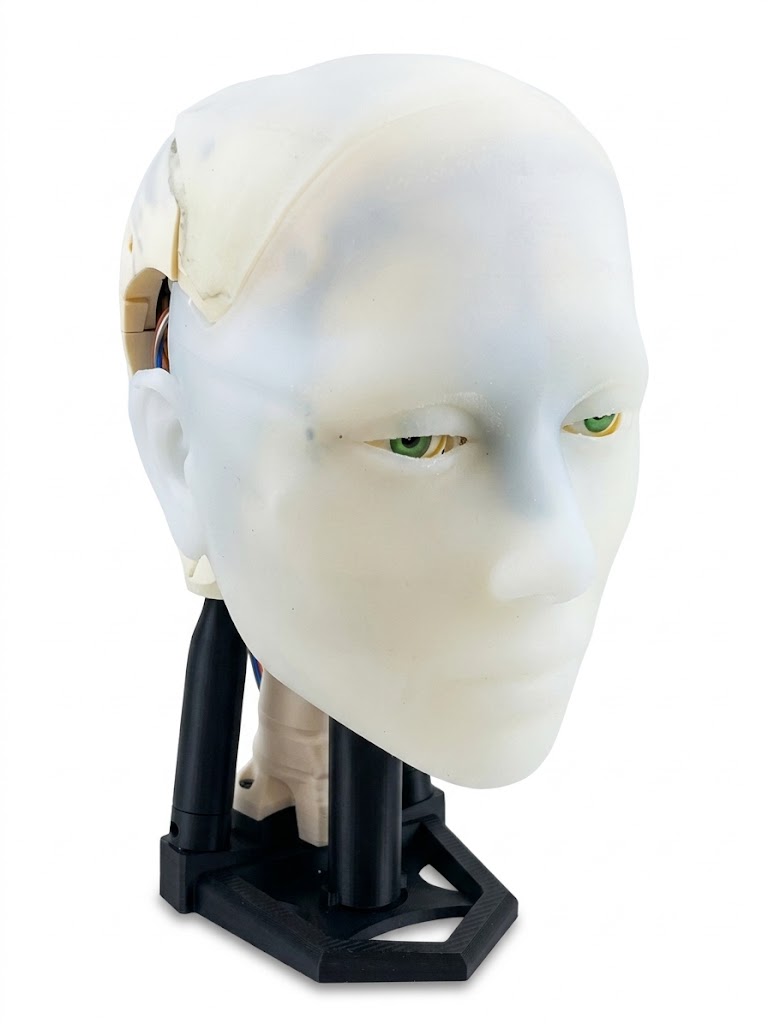
Inmoov i2 head on stand. Face held in place by magnets.
When a Mechanism Becomes a Social Object
This was also the point at which I began to think about the head rather differently. A moving mechanical eye is clearly a mechanism. Put that same eye behind a recognisable human face and its movement becomes gaze.
The important point is that these meanings do not necessarily exist within the mechanism itself. Much of the interpretation is supplied by the person observing it. This is one of the reasons that social robotics is such an interesting area of human–robot interaction. Human beings are remarkably inclined to interpret movement and appearance socially. A robot can therefore communicate through much more than spoken language. Its posture, orientation, distance, gaze, timing, facial expression, gesture, sound and movement can all potentially convey information.
For me, that makes the InMoov head particularly interesting. Rather than thinking of the face simply as a cosmetic covering for the mechanism underneath, it can be considered an experimental communication interface.
From Social Robotics to Inclusive Social Robotics
Many social robots have historically been designed around assumptions about how people communicate: that users will recognise a facial expression, understand a gesture, hear spoken instructions, maintain visual attention, respond within an expected period of time or interact with a robot in a relatively predictable way. But people do not all communicate or interpret communication in the same way (something we have been exploring in the recent RobotLab Workshops).
A facial expression that is immediately recognisable to one person may be ambiguous to another. Eye contact may be useful to some people and uncomfortable or inaccessible to others. Spoken language may work extremely well for one participant while another may prefer symbols, physical objects, gesture, sound, colour, touch or movement.
This is where the project begins to connect with Inclusive Human–Robot Interaction (IHRI). Rather than asking only:
How can I make this robot communicate like a person?
I am increasingly interested in asking:
How might different people want this robot to communicate with them?
And, even more importantly:
How can people who are frequently excluded from the design of robotic technologies participate in deciding how future robots should communicate?
That changes the role of the robot considerably. Instead of presenting participants with a finished social robot and asking whether they can use it, the robot becomes a platform that can be changed, questioned and redesigned. Somehow.
The Face as an Experimental Platform
The InMoov design (though not hugely flexible) does actually create some particularly interesting possibilities. The silicone face is removable. The underlying mechanisms are accessible. Expressions can potentially be altered through software. Eyes, eyelids, mouth, cheeks and other components can be controlled independently.
This means that the robot’s social behaviour does not have to be treated as fixed. Future workshops could investigate individual elements of expression separately. For instance:
- What happens, for example, if the robot looks directly at somebody?
- What does it appear to be communicating if it looks away?
- How should a robot indicate that it has heard an instruction? (something we discussed recently)
- How should it show that it has not understood?
- What should a robot do if it wants somebody to repeat something?
- How might it indicate uncertainty?
- What does a participant think the robot is feeling when its eyes, eyelids or mouth occupy different positions?
- And do participants agree about any of these interpretations?
The disagreement may actually be more interesting than agreement. If different people interpret exactly the same robotic expression differently, that challenges the assumption that there is necessarily one universally understandable way for a robot to communicate.
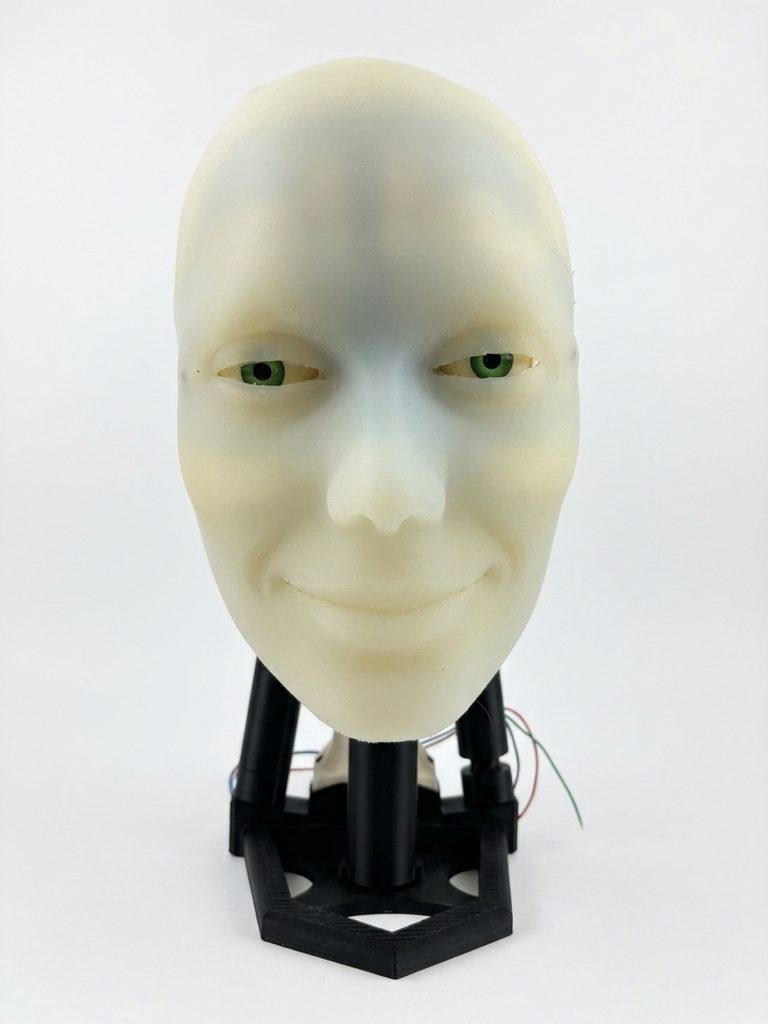
What the Inmoov head could look like when smiling (Generated from original image by Gemini)
Beyond Facial Expression
The head provides an opportunity to explore multimodal communication, which was one of the main ideas we discussed in depth in the recent Robot Lab Workshops. Facial expression could be combined with speech, non-verbal sounds, head movements, gaze, lights, symbols or other sensory cues. Eventually these could form part of a larger robotic system incorporating gesture and movement.
A participant might therefore be presented with several different ways for the robot to communicate the same intention.
For example, suppose the robot wants to communicate: “I don’t understand.”
It could say the words.
It could tilt its head.
It could change its facial expression.
It could look away and back again.
It could make a questioning sound.
It could display a symbol.
Or it could combine several of these behaviours.
Rather than researchers deciding which behaviour is “correct”, participants could experiment with these possibilities and create their own.
This is where I think the project could become particularly powerful. The robot becomes not simply something that participants interact with, but something they can participate in designing.
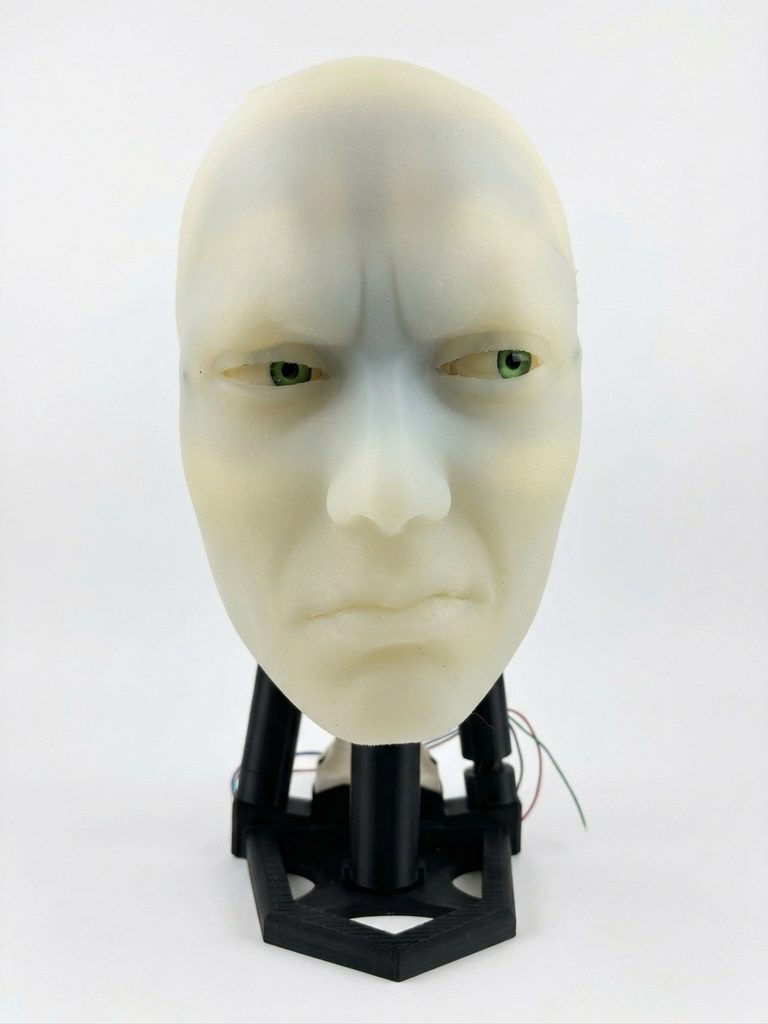
What the Inmoov head could look like when puzzled (Generated from original image by Gemini)
Designing With Rather Than Designing For
Inclusive robotics should not simply mean building robots for people who have previously been excluded from technology. It should also mean creating opportunities for those people to influence what future robotic technologies become. That means moving from designing for people to designing with people.
In future experiments, participants could therefore be invited to become robot designers themselves. They might choose expressions for the robot. They might invent gestures, decide whether eye contact is useful, they might combine sounds and facial movements and might deliberately exaggerate expressions.
They might also decide that a conventional human expression is completely inappropriate and invent something new. They might even decide that the robot does not need a human face at all. All of these outcomes would be valuable.
The objective would not necessarily be to discover the single “best” interface. It may instead be to understand the diversity of ways in which people would like robots to express intention, acknowledgement, uncertainty, emotion and action.
Appearance as a Variable
The removable face introduces another particularly interesting experimental possibility: the robot can potentially be presented at different levels of human likeness.
At one extreme is the completely exposed mechanical head, with its servos, linkages and printed components clearly visible. The silicone skin introduces a recognisable human face. Other faces could potentially be produced later, varying features such as realism, expression, colour or degree of abstraction.
This raises questions about embodiment itself.
Does making the robot more human-like make its intentions easier to understand?
Does it make people more willing to interact with it?
Does a clearly mechanical robot feel more predictable?
Could a stylised face be more effective than a realistic one?
At what point does increasing realism stop improving interaction and begin to make the robot uncomfortable or unsettling?
And crucially for inclusive HRI: Do different people want different kinds of robot?
There is no reason to assume that there will be one answer.
From Robot Head to Research Instrument
The next stage of the project will be to begin experimenting with the head as an interactive system rather than simply a mechanical one. That could include programming repeatable facial expressions and gaze behaviours, exploring different ways of indicating attention and understanding, experimenting with combinations of visual and auditory communication and eventually allowing participants themselves to control or create the robot’s behaviours. There is also considerable potential for introducing AI, although I think this should come later rather than becoming the starting point.
A future version of the system might recognise speech, respond to gestures or other signals, maintain conversational context, adapt its behaviour or select different communication modalities according to an individual’s preferences.
But the important principle is that the technology should not determine what counts as successful interaction. The people interacting with it should.
Perhaps the most interesting thing about constructing the head, then, is that I began by trying to build a face. What has now emerged is a way of asking questions. Questions about expression, communication, about embodiment and about who robots are designed for.
And, most importantly, questions about who should have the opportunity to shape the robots with which we may one day share our homes, workplaces, schools and communities.